
Cuba Inside the Experience: A Destination That Rewards Awareness
Cuba reveals itself slowly, rewarding travelers who observe before judging and stay present when convenience gives way to awareness and lived context.
THOUGHTFUL TRAVEL
2/1/20262 min read
By Jeanne Crouse
Writing about destinations that reward patience, context, and a more intentional way of traveling
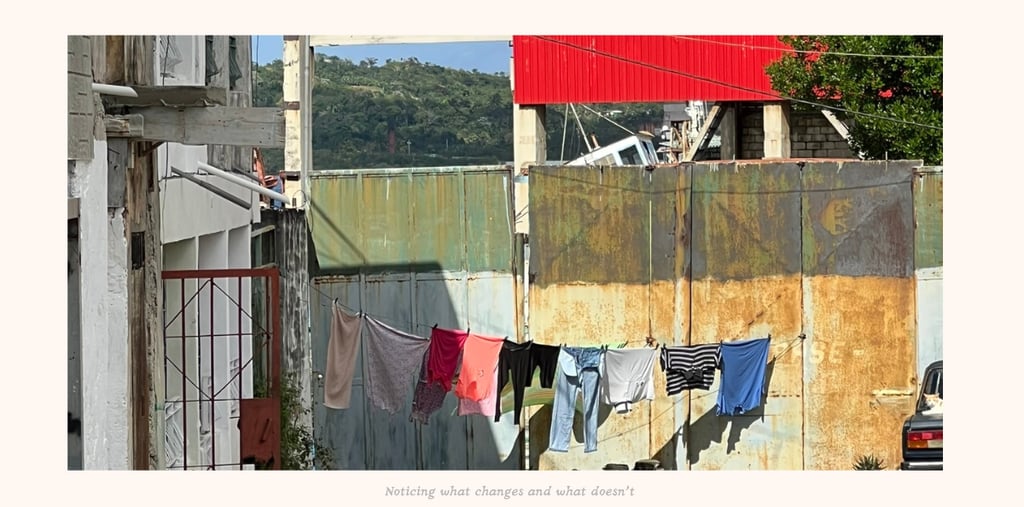
This short reflection is part of an ongoing series of observations from Cuba - quiet moments that reveal how travel changes when context, not convenience, sets the terms.
Cuba doesn’t reveal itself all at once.
Unlike destinations that present their highlights clearly and immediately, Cuba unfolds slowly. What it offers isn’t front-loaded or optimized for quick understanding. The meaning lives in accumulation - in repeated encounters, in ordinary scenes revisited, in moments that seem unremarkable until they begin to connect.
This kind of travel rewards awareness.
Awareness, here, is not about expertise or preparation. It’s about attention. Observing before interpreting. Listening before evaluating. Allowing context to emerge rather than forcing conclusions. The more time you spend watching how daily life moves: how people adapt, wait, negotiate, and improvise - the clearer the larger picture becomes.
In Cuba, convenience rarely sets the rhythm. Availability does. Schedules bend. Plans adjust. Systems respond to circumstance rather than demand. For travelers used to environments designed around predictability, this can feel disorienting. For those willing to stay present, it becomes instructive.
What starts to matter are the small things: how conversations begin without urgency, how patience is practiced rather than praised, how resilience shows up quietly in routine moments. These aren’t dramatic revelations. They’re subtle, cumulative, and easy to miss if attention drifts toward what’s missing instead of what’s happening.
Awareness also means resisting the urge to explain everything too quickly. Cuba is often interpreted through headlines, history, or ideology - but lived experience rarely fits neatly into those frames. Daily life here contains contradiction and complexity: humor alongside hardship, constraint alongside creativity. Allowing those tensions to exist without resolution is part of understanding the place.
This doesn’t mean withholding judgment indefinitely. It means postponing it long enough for context to do its work. The longer you observe, the less inclined you may feel to simplify. And in that restraint, perception sharpens.
Travel in Cuba tends to shift the role of the traveler. You become less of an evaluator and more of a witness. Less focused on access and more attentive to presence. Meaning emerges not through highlights, but through continuity: returning to the same street, the same café, the same conversation, and noticing what changes and what doesn’t.
These moments aren’t meant to explain the country. They show what travel looks like when convenience is no longer the organizing principle and when awareness becomes the primary way of engaging with a place.
Cuba doesn’t demand attention.
But it rewards it.
Follow Us
Contact Us
Jeanne@CurioTravel.net
910-338-6978
© 2026 All rights reserved